








Car Battery Life
Your car’s battery sits tucked away beneath the hood in the corner of your engine compartment. It’s small compared to the engine, yet plays a critical role in the operation of your vehicle. Understanding how your battery works will help you learn how to care for it and spot the warning signs before failure occurs. If you’re concerned about your car battery’s life, call the Performance CJDR service center at (937) 434-9500.
How Your Battery Works
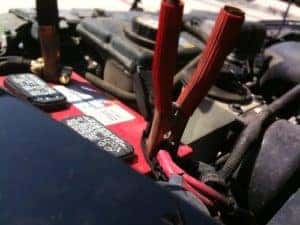
Image via Flickr by Charles Williams | CC 2.0
That battery may look small and insignificant next to your engine, but the engine is nothing without it. If your battery dies, your engine won’t start, and you can’t go anywhere. Unfortunately, all batteries eventually fail.
Car batteries perform a simple function, converting chemical energy into electrical energy. After conversion, the battery delivers the electricity necessary to start your engine. The battery’s job doesn’t stop here, as it continues to provide power to other electrical systems.
The entire system that operates your vehicle is a continuous energy conversion cycle. It begins with the battery converting chemical energy into electrical energy and delivering it to your starter. Then, the starter sends the electricity into the spark plugs, which ignite the gasoline in the pistons of your engine. Now, your engine has converted the electrical energy into mechanical energy that powers your drivetrain and moves your car.
In addition to moving your vehicle, the engine also operates your alternator. This device converts the mechanical energy into electrical energy before sending it back to the battery for storage. In this way, you have the electrical power available the next time you need to start your vehicle.
How Does a Battery Fail?
Batteries fail for various reasons. Age, of course, always affects your battery, but it isn’t simply the battery running out of power. It’s the battery failing to retain power. This is because your battery contains acid, a corrosive liquid. Over time, the metal plates within your battery become degraded by the corrosion, and the battery loses its ability to store energy.
Weather plays a role too. Extreme cold can cause your battery to fail. Science has proven that your car’s battery weakens by 35% at 32 degrees. Furthermore, when the temperature hits zero degrees, a battery weakens by 60%. Therefore, it is far more likely to fail in cold weather if your battery is compromised by age and corrosion.
In addition, leaving electrical systems running, such as the lights or radio, when the engine isn’t on, can drain your battery. In this case, you may not need to replace your battery, but you will need to recharge it.
A failing alternator might end your battery’s life prematurely. If the alternator doesn’t return power to the battery, the electrical systems draw power from the battery until no more remains, thus leading to battery failure. This occurs much more often than you might imagine but doesn’t necessarily mean you must replace your battery. You can bring your car to our Express Lane and one of our technicians can quickly test to determine if the problem lies with your battery or alternator.
Signs Your Battery Might Be Failing
Fortunately, we can predict a failing battery by paying attention to the signs. If you notice your engine strain to start, you might have a failing battery. Other common symptoms include the lights dimming and other electrical systems not activating as you try to start your vehicle. Once your engine starts, these systems typically begin working normally. The normal function returns because the alternator powered by the running engine provides electrical energy to the systems.
Sulfation is a natural byproduct of the recharging process that occurs over time. This symptom usually presents itself as a blue or green growth like algae that blooms on your battery’s terminals. Sulfation prevents your battery from recharging properly. If this occurs, we recommend having one of our technicians test your battery immediately to avoid a possible failure.
How Long Do Batteries Last?
Most batteries were built to last between two and five years. Usage and weather can cause a battery to fail more quickly. We recommend testing your battery at every oil change to ensure proper function. To encourage our customers to keep up with maintenance, we offer a rotating list of service specials online, including deals on battery replacement.
What To Do When Your Battery Dies
If you’ve never experienced battery failure, you’re one of the lucky few. However, we suggest everyone prepare for battery failure. At the very least, you should have jumper cables in your emergency kit. Jumper cables enable you to draw energy from another car’s battery to start your vehicle. Simply attach one end to the running vehicle’s battery terminals and the other end to your car’s battery terminals. Give it a moment to allow the current to transfer and then start your vehicle.
Once started, we recommend you immediately come to our service center to determine the cause and fix it. Jump starting your car is a temporary fix. If you turn your engine off, you may not be able to start it again with a failed battery or alternator.
You can purchase a portable jump kit for under $100. A jump kit works like jumper cables but has its own battery, thus eliminating the need for another car to provide power. If you travel long distances or late at night, you can imagine the difficulty you might have in finding another vehicle to jumpstart your car.
At Performance Chrysler Jeep Dodge Ram Centerville, we know the importance of having a battery you can rely upon. If you believe you have a failing battery or suspect you have a problem with your alternator, we recommend you bring your vehicle in for a checkup. You can conveniently schedule service online or stop by our service center on Loop Road at any time.
One of our factory-certified technicians will quickly determine the problem and provide you with the appropriate solution. We can replace your battery in less than 20 minutes in most cases. Replacing your alternator takes a little more time, but usually, we can do this in less than one hour, getting you back to your busy life quickly.


0 comment(s) so far on Car Battery Life